
1Course Objectives
This short opening section states what the learner must be able to do by the end of Unit 10. It sets the three word families that structure the whole lesson: places, actions and styles of holiday.
- Objective 1: identify and name tourist attractions in English (natural, historical/cultural, urban, modern).
- Objective 2: describe vacation activities using correct verb phrases, especially the pattern go + -ing.
- Objective 3: distinguish the main vacation types (beach, adventure, cultural, ecotourism, cruise, city break, package tour, backpacking) and their purposes.
- Objective 4: decode a tourist brochure by separating places (nouns) from actions (verbs).
- Objective 5: avoid frequent collocation traps caused by word-for-word translation from French or Arabic (e.g. touristic, make camping, pass my holidays).
- Objective 6: combine a TYPE + an ATTRACTION + an ACTIVITY to describe a holiday in a short written paragraph (60-80 words).
Three Word Families of Unit 10
Place
the attraction — the destination you travel to and explore (e.g. a medina, a mountain, a beach).
Action
the activity — what you actually do while you are there (e.g. go hiking, go sightseeing).
Style
the type — the overall kind of holiday you choose (e.g. adventure tourism, a city break).
By the end of this unit, you should be able to move confidently between these three families of words - place, action, and style - and use them together to build accurate, natural sentences about vacations.
2Warm-up and Prerequisites: Travel Words You Already Know
Before learning new words, the lesson reactivates the basic travel vocabulary met in previous units and introduces the three-part logic of the unit: a place, an action, a style.
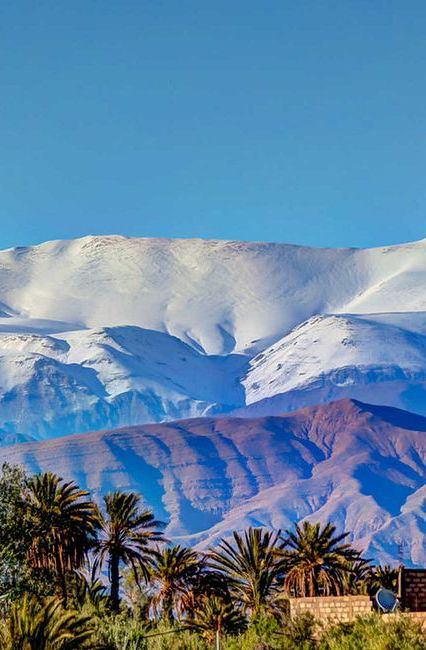
Warm-up question: "If you had one week off, would you rather climb the Atlas Mountains, walk through the medina of Fes, or relax on a beach in Agadir?" Think about your answer and notice that it already contains a place, an action, and a style of holiday.
Three Pillars of Unit 10
A Place
The attraction — the destination you travel to and explore (e.g. the Atlas Mountains, the medina of Fes).
An Action
The activity — what you actually do while you are there (e.g. climb, walk through, relax).
A Style
The type — the overall kind of holiday you choose (e.g. an adventure holiday, a cultural trip, a beach vacation).
Today's mission: learn the words to describe WHERE you go, WHAT you do, and WHICH KIND of holiday you choose.
Word | Form | Example |
|---|---|---|
to travel | verb | "I travel to Tangier every summer." |
a trip | noun | "We took a short trip to Chefchaouen." |
a tourist | noun | "Many tourists visit Marrakech in spring." |
to visit | verb | "She visits her grandparents in Essaouira." |
abroad | adverb | "My cousin studies abroad." |
to travel
the action of moving from one place to another, often for pleasure or work.
a trip / a journey
the event itself — a specific instance of travelling from one place to another.
a tourist
a person who travels for pleasure and visits places of interest.
Key Distinction to Remember
Travel is the action (the verb).
A trip / a journey is the event (the noun for the whole experience).
A tourist is the person who travels for pleasure.
Plan du chapitre
Sur cette page
Dans la classe
- 3Tourist Attractions: Places People Visit
- 4Vacation Activities: Action Verbs and Phrases
- 5Vacation Types: Choosing the Right Holiday
- 6Useful Collocations and Expressions
- 7Common Mistakes and Pitfalls
- 8Guided Practice: Decoding a Tourist Brochure
- 9Quick Application: Classify, Complete, Self-Check
- 10Key Points to Remember